⚠️ Research Use Only (RUO). Not for human or veterinary use. All content on this page is provided for educational and scientific reference purposes only.
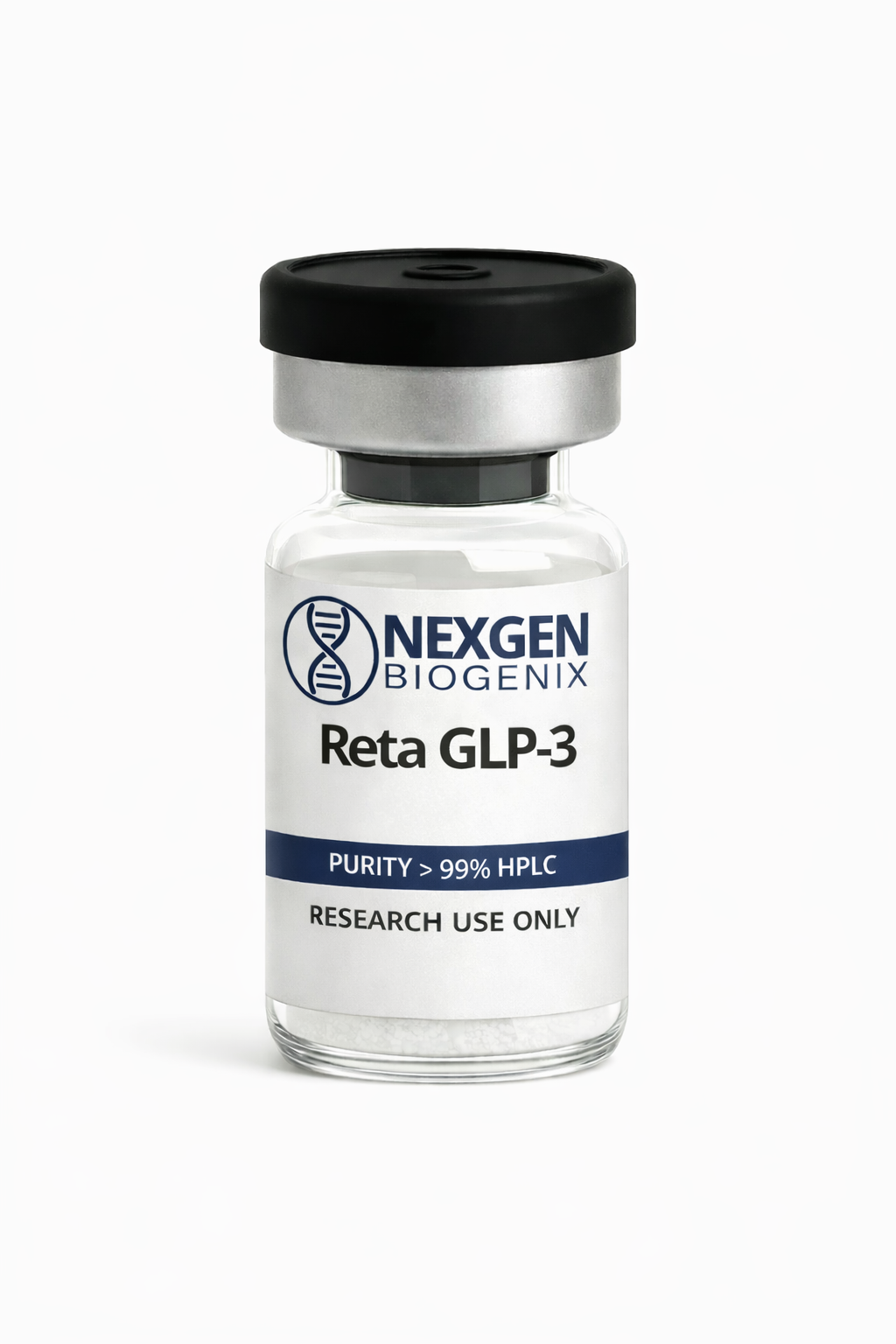
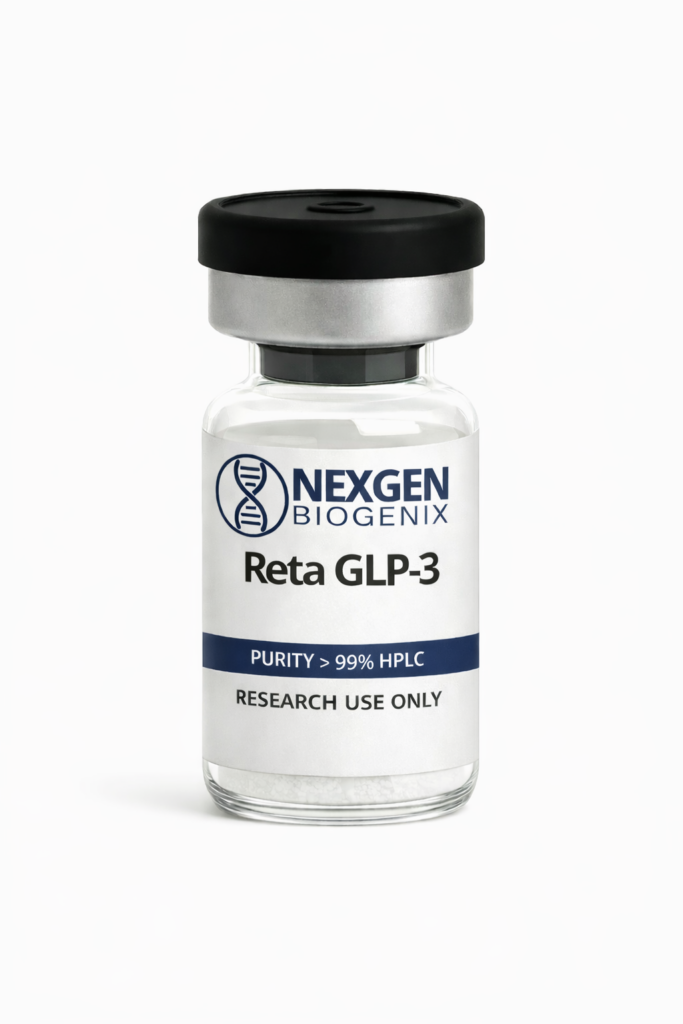
Retatrutide (Reta GLP3) — Research Overview (RUO)
Quick Facts
- Full name: Retatrutide
- Common name / abbreviation: Reta GLP3; LY3437943; LY-3437943
- Synonyms / related names: Triple Hormone Receptor Agonist; GIP/GLP-1/GCGR tri-agonist
- Peptide class: Synthetic incretin-based tri-agonist peptide (39 amino acids; GIP backbone with modified residues and C20 fatty diacid conjugation)
- Molecular formula: C221H342N46O68
- CAS number: 2381089-83-2
- Primary research themes: Obesity and metabolic dysfunction research; glycemic regulation models; hepatic steatosis (MASLD/MASH) research; cardiometabolic biomarker studies
- Evidence level: Preclinical (in vitro / animal models) and early human data (Phase 2 published; Phase 3 trials ongoing as of 2025–2026)
- Regulatory status: Investigational New Drug (IND) only — not FDA-approved for any indication; available exclusively within regulated clinical trials; classified RUO when sold for laboratory research
What Is Retatrutide (Reta GLP3)?
Retatrutide — sometimes called Reta GLP3 or by its development code LY3437943 — is a synthetic 39-amino-acid peptide engineered by Eli Lilly and Company. The human body naturally produces many peptides — small protein-like molecules that act as biological messengers — and retatrutide is a laboratory-designed analog built on a GIP (glucose-dependent insulinotropic polypeptide) backbone. Its structure incorporates three non-standard amino acid residues (Aib2, Aib20, and α-methyl-L-leucine at position 13) along with a C20 fatty diacid lipid conjugation, a chemical engineering strategy the literature describes as conferring protease resistance and extended plasma half-life of approximately six days.
What sets retatrutide apart in the research literature is its simultaneous agonist activity at three distinct G-protein-coupled receptors: the GLP-1 receptor (GLP-1R), the GIP receptor (GIPR), and the glucagon receptor (GCGR). Most earlier peptides in this class targeted only one or two of these receptors. Researchers and study authors have proposed that engaging all three pathways in a single molecule may produce additive or synergistic effects on energy balance, glucose metabolism, and hepatic fat — though the exact mechanism and its translation to humans has not been fully established.
Retatrutide is currently an Investigational New Drug (IND) under evaluation in Eli Lilly’s TRIUMPH Phase 3 clinical trial program. It is not approved by the FDA for any clinical indication, and any product sold outside of regulated clinical trials is unapproved for human use under US federal law. In the research and scientific supply context, retatrutide is sold for in vitro laboratory use only, under Research Use Only (RUO) classification.
Why Do Researchers Study It?
Researchers are interested in retatrutide because it represents one of the most advanced examples of a next-generation triple incretin receptor agonist, allowing scientists to investigate what happens when three complementary metabolic hormone pathways are activated simultaneously within a single molecular scaffold. Its published Phase 2 data and growing body of preclinical work have made it a subject of broad scientific attention.
- Obesity and energy homeostasis models: The compound has been studied in animal models and Phase 2 human trials for its effects on body weight and adiposity. Researchers use it to probe the neuroendocrine mechanisms underlying energy intake reduction and expenditure.
- Glycemic regulation: Scientists are investigating how combined GLP-1R and GIPR agonism coordinates glucose-dependent insulin secretion and how glucagon receptor activity interplays with glycemic control — particularly in type 2 diabetes (T2D) models.
- Hepatic steatosis and MASLD/MASH research: Studies suggest retatrutide may substantially reduce liver fat in preclinical and early human models, making it a research tool for metabolic dysfunction-associated steatotic liver disease (MASLD) and its inflammatory form (MASH).
- Lipid metabolism: The glucagon receptor component has been described in the literature as promoting fatty acid oxidation and possibly influencing PCSK9 degradation, with researchers examining downstream effects on lipid profiles.
- Cardiometabolic biomarker studies: Phase 2 data showed changes in waist circumference, blood pressure, fasting glucose, HbA1c, and lipid panels, prompting further mechanistic research into the compound’s cardiometabolic signaling.
- Receptor pharmacology: Because retatrutide activates GCGR, GIPR, and GLP-1R at different potencies (reported EC50 values of approximately 5.79 nM, 0.064 nM, and 0.775 nM, respectively), it is used as a research tool to dissect individual receptor contributions in cell-based and animal assays.
Proposed Mechanism (Research Framing)
The following mechanistic descriptions are drawn entirely from published preclinical and early clinical literature. They represent researchers’ current hypotheses and observations, not established clinical facts. The exact mechanism of action in humans has not been fully established, and all claims should be understood within that context.
Studies suggest that retatrutide’s simultaneous activation of three receptor systems converges on several overlapping metabolic pathways. At the GLP-1 receptor — the same target engaged by approved agents like semaglutide — researchers have observed glucose-dependent stimulation of insulin secretion from pancreatic beta cells, suppression of glucagon from alpha cells, and delayed gastric emptying, effects the literature associates with reduced appetite signaling in both peripheral and central nervous system models. GIP receptor agonism has been described in the literature as amplifying insulin release in normoglycemic and hyperglycemic states and potentially influencing adipose tissue lipolysis. The glucagon receptor component, researchers have proposed, may enhance hepatic fatty acid oxidation, suppress de novo lipogenesis, and — in animal models — stimulate thermogenesis in brown adipose tissue, though human experiments have not demonstrated more than a modest effect on energy expenditure beyond what is attributed to weight loss itself.
The lipid-diacid conjugation on the molecule’s lysine residue at position 17 is described in the development literature as enabling reversible albumin binding in plasma, a strategy observed in preclinical models to extend circulating half-life and support once-weekly dosing. Non-standard amino acids at positions 2 and 20 (2-aminoisobutyric acid, Aib) are reported to resist cleavage by the enzyme DPP-4, which would otherwise rapidly degrade native GLP-1 and GIP. The third non-standard residue, α-methyl-L-leucine at position 13, has been described by Eli Lilly researchers as important for maintaining appropriate GIP activity and glucagon receptor agonism simultaneously.
It is important to note that the balance of receptor activation — and how that balance translates to net metabolic outcomes — involves complex, interconnected signaling that is still being characterized. Findings from cell lines and rodent models do not always predict human responses, and the relative contributions of each receptor arm in clinical settings remain an active area of investigation.
Key Targets Described in the Literature
- GLP-1 receptor (GLP-1R): Expressed in pancreatic beta cells, brain, gut, and heart; described as mediating glucose-dependent insulin release and appetite suppression
- GIP receptor (GIPR): Expressed in pancreatic beta cells, adipose tissue, and neural tissue; described as amplifying insulin secretion and modulating lipid metabolism
- Glucagon receptor (GCGR): Highly expressed in hepatocytes; described in preclinical models as promoting glycogenolysis, fatty acid oxidation, and thermogenesis
- DPP-4 cleavage site (blocked): The Aib2 modification has been described as protecting the N-terminal region from rapid enzymatic degradation, extending biological activity in assay systems
- Albumin binding via lipid tail: The C20 fatty diacid conjugation is described in the discovery literature as enabling extended plasma residence through reversible binding to serum albumin
Research Applications (RUO Context)
In laboratory research settings, retatrutide is used as a pharmacological tool to investigate incretin biology, receptor pharmacology, and metabolic signaling. The following applications reflect how qualified researchers have used or are using this compound in non-clinical contexts. No protocols, dosing instructions, or guidance for human use are provided or implied.
- Receptor binding and activation assays: Used in cell-based models to measure agonist potency at GLP-1R, GIPR, and GCGR; assists researchers in characterizing structure-activity relationships for tri-agonist scaffolds
- In vitro glucose metabolism studies: Applied in pancreatic beta-cell lines (e.g., MIN6, INS-1) to study glucose-dependent insulin secretion and glucagon suppression pathways
- Rodent obesity and metabolic syndrome models: Used in diet-induced obese (DIO) mice and db/db diabetic mice to model body weight change, glucose tolerance, and hepatic fat content; preclinical studies have described significant weight reduction and improved metabolic parameters in these models
- Hepatic steatosis research: Applied in animal models of MASLD/MASH to study the effects of concurrent GLP-1R, GIPR, and GCGR activation on liver fat content, inflammation markers, and fibrosis-related biomarkers
- Cancer biology research: Emerging preclinical studies have explored retatrutide’s effects in tumor-bearing mouse models; one published study described tumor burden reduction in lung adenocarcinoma mice, though these findings are early-stage and not translatable to clinical oncology without further work
- Pharmacokinetic profiling studies: Used to study the influence of lipid conjugation and non-natural amino acid substitutions on peptide half-life, albumin binding, and metabolic stability in plasma and tissue assays
Evidence Snapshot
► Preclinical Evidence (In Vitro / Animal Models)
- The discovery paper by Coskun et al. (2022) in Cell Metabolism described retatrutide (LY3437943) as demonstrating weight reduction, improved glycemic control, and favorable pharmacokinetics in rodent models, including DIO mice, providing the foundational preclinical characterization of the compound.
- Studies in db/db diabetic mice have observed that retatrutide treatment was associated with reductions in markers of kidney inflammation and fibrosis (TNF-α, NLRP3, collagen I), though researchers note this is early-stage preclinical data requiring substantial further work before any clinical relevance can be assessed.
- Preclinical cancer models have described retatrutide as reducing tumor burden in lung adenocarcinoma and triple-negative breast cancer xenograft mouse models, effects researchers have proposed may relate to metabolic pathway modulation — these findings are highly preliminary and not indicative of any clinical application.
- In vitro receptor assays have consistently characterized retatrutide as binding to human GCGR, GIPR, and GLP-1R with sub-nanomolar to low-nanomolar potency, making it a useful tool compound for studying each receptor’s individual contribution when applied alongside selective blockers.
► Human / Clinical Evidence
- A Phase 2, double-blind, randomized, placebo-controlled trial published in the New England Journal of Medicine (Jastreboff et al., 2023) enrolled 338 adults with obesity (without type 2 diabetes) and observed a mean weight reduction of up to 24.2% at 48 weeks in the highest-dose group, along with improvements in cardiometabolic markers including waist circumference, blood pressure, fasting glucose, and lipid parameters. This is Phase 2 data — not Phase 3, and not FDA-approval-level evidence.
- A second Phase 2 trial published in The Lancet (Rosenstock et al., 2023) evaluated retatrutide in adults with type 2 diabetes and reported dose-dependent reductions in HbA1c and body weight, with 77–82% of participants in the highest-dose groups achieving HbA1c ≤ 6.5% at 36 weeks. Again, this represents Phase 2 data only.
- A Phase 2a substudy published in Nature Medicine (Sanyal et al., 2024) observed up to an approximately 82% relative reduction in liver fat at 24 weeks in participants with MASLD who received the highest doses of retatrutide, compared to near-zero change with placebo. These are early human data from a single substudy and require confirmation in larger, longer trials.
- As of early 2026, Phase 3 large-scale randomized controlled trials (the TRIUMPH program) are ongoing and expected to report results through 2026. No Phase 3 data sufficient to support regulatory approval have been published. Researchers and clinicians should monitor ClinicalTrials.gov and peer-reviewed literature for updates.
Limitations & Open Questions
Retatrutide’s research profile is unusually rich for an investigational compound, but significant gaps and uncertainties remain. The following limitations are relevant to any scientific or laboratory use of the published literature.
- Phase 2 ≠ approval-level evidence: All human data published to date comes from Phase 2 trials. Phase 3 results are needed to establish replicability, safety in larger and more diverse populations, and long-term outcomes. Phase 2 results are not always confirmed in Phase 3.
- Translation from animal models: Rodent metabolic physiology differs substantially from human physiology. Findings from DIO mice or db/db models — while scientifically informative — cannot be directly extrapolated to human outcomes.
- Long-term safety profile: The longest published human trial data extends to 48–68 weeks. Long-term cardiovascular safety, effects on bone density, thyroid, and other organ systems are not yet fully characterized. A modest but consistent increase in heart rate was noted in Phase 2 studies and is under evaluation in Phase 3.
- Receptor balance uncertainty: The optimal ratio of GLP-1R, GIPR, and GCGR agonism for different metabolic outcomes in humans has not been definitively established. Researchers have proposed multiple competing hypotheses about which receptor arm drives which benefit.
- Purity and standardization in RUO supplies: Research-grade peptides sourced outside of clinical-trial-grade manufacturing vary in purity and quality. Certificate of Analysis (COA) documentation, lot traceability, and independent analytical verification are essential for reproducible research results.
- Regulatory uncertainty: Retatrutide remains an unapproved investigational drug in the US and globally. Its compounding is prohibited under US federal law. Regulatory status may change, and researchers must monitor FDA guidance and relevant regulatory counsel for updates.
Quality & Sourcing
For laboratory research applications, the reliability of any experimental finding depends critically on the quality and traceability of the research compound used. When evaluating any RUO-grade retatrutide supply, researchers should consider the following documentation standards.
- Lot Traceability: Each batch should be accompanied by a unique lot number traceable to the manufacturer’s production records. Lot-specific documentation allows researchers to assess inter-batch consistency and ensures findings can be attributed to a defined material.
- Certificate of Analysis (COA): A full COA should include identity confirmation (typically HPLC and mass spectrometry data), purity percentage (≥98% is standard for high-quality research peptides), residual solvents, and endotoxin testing where applicable. Researchers should request and review COA documentation before use in any assay system.
- Storage & Labeling: Lyophilized retatrutide is typically stored at or below −20°C, protected from moisture and light, under inert atmosphere. Products should be clearly labeled as Research Use Only, with no instructions for human use, no dosing guidance, and no therapeutic claims on any labeling or accompanying materials.
📄 Questions about documentation or purity verification? Contact our support team or request a COA from our library.
US Regulatory Snapshot (Updated 2025)
- RUO classification: Retatrutide, when sold for laboratory use, is classified as a Research Use Only (RUO) compound. It is not a drug, not a dietary supplement, and not a cosmetic. RUO products are not subject to FDA drug approval requirements but may not be sold, labeled, or marketed for human therapeutic use. FDA has taken enforcement action against sellers of RUO peptides when evidence suggests the products were intended for human use, including where dosing instructions, syringes, or therapeutic claims accompanied the product.
- Category 1 / 503A — what it means (and does not mean): Under the FDA’s interim compounding policy, Section 503A of the FD&C Act governs traditional compounding pharmacies. “Category 1” refers to bulk drug substances that have been nominated for the 503A Bulks List, are currently under evaluation, and for which FDA has not yet identified significant safety risks — meaning FDA has stated it does not intend to take enforcement action against pharmacies compounding those specific substances while evaluation is pending. Category 1 designation is not FDA approval. It does not mean a substance is safe or effective, is authorized for patient use, or has been reviewed under the drug approval standard. Retatrutide is an investigational drug under active IND; it is not on the 503A Bulks List and is not eligible for compounding under 503A or 503B. FDA has issued warning letters describing compounded retatrutide products as unapproved new drugs when marketed in interstate commerce.
- FDA January 7, 2025 guidance: In its final interim guidance published January 7, 2025 (Docket No. FDA-2015-D-3517), FDA clarified that while it will continue to receive and evaluate new nominations of bulk drug substances for the 503A Bulks List, it does not intend to place newly nominated substances into interim Category 1 (or any other interim category) prior to completing its full evaluation under Section 503A(c). This represents a tightening of the interim policy: substances nominated after January 7, 2025 will not receive a “Category 1” interim designation during review. Researchers and compounders should consult FDA.gov directly and work with qualified regulatory counsel to understand the implications for any specific substance.
- Retatrutide-specific regulatory status (as of March 2026): Retatrutide is an Investigational New Drug (IND) developed by Eli Lilly and Company. As of early 2026, it has not been approved by the FDA for any indication — not for obesity, not for type 2 diabetes, not for any other use. It is available only within approved Eli Lilly-sponsored clinical trials (the TRIUMPH program). It is not on the 503A or 503B Bulks Lists and cannot be legally compounded. FDA has issued warning letters targeting companies selling “research grade” GLP-1 and related peptides — including retatrutide — when evidence of intended human use is present. Phase 3 trial data readouts are expected through 2026; potential NDA submission and regulatory review could follow, but no approval has been granted or guaranteed.
- Stay current: Regulatory status for investigational compounds can change rapidly. Researchers, institutions, and supply-chain professionals should monitor FDA.gov, ClinicalTrials.gov, and the FDA’s Human Drug Compounding page for the most current guidance, and consult a qualified regulatory attorney or compliance professional for institution-specific guidance.
Frequently Asked Questions
Does the body naturally produce peptides like the ones studied in this research area?
Yes. The human body naturally produces many peptides — small protein-like molecules that act as biological messengers throughout the body. Familiar examples include insulin (which regulates blood sugar), glucagon (which raises blood sugar when it drops too low), GLP-1 and GIP (incretin hormones released from the gut after eating that help coordinate the insulin response), oxytocin (involved in social bonding and childbirth), and endorphins (involved in pain modulation). Retatrutide is a laboratory-engineered synthetic analog designed to interact with receptors for some of these naturally occurring peptide signals — specifically GLP-1, GIP, and glucagon. Understanding how these endogenous peptide systems work is one reason scientists study synthetic analogs like retatrutide in preclinical and early clinical research settings.
Is retatrutide FDA-approved?
No. As of early 2026, retatrutide is not approved by the US Food and Drug Administration for any indication. It is an Investigational New Drug (IND) being evaluated in Phase 3 clinical trials (the TRIUMPH program) sponsored by Eli Lilly and Company. It cannot be legally prescribed outside of an approved clinical trial in the United States. It cannot be legally compounded by 503A pharmacies or 503B outsourcing facilities. Any product sold or marketed online claiming to be FDA-approved retatrutide is making a false or misleading claim. Products of unknown provenance sold as “research peptides” carry unknown purity, identity, and safety risks. The FDA has issued warning letters targeting sales of unapproved GLP-1-related compounds, including retatrutide. Nothing on this page constitutes an endorsement of any clinical or personal use.
Is any information on this page medical advice?
No. Nothing on this page constitutes medical advice, clinical guidance, therapeutic recommendations, or dosing instructions of any kind. This page is educational and scientific reference material provided for qualified researchers. All products described on this website are intended exclusively for in vitro laboratory research by qualified scientists. If you have questions about your health, weight, diabetes, or any medical condition, please consult a licensed healthcare provider. If you are interested in participating in clinical research involving retatrutide, you may search for actively enrolling trials at ClinicalTrials.gov.
References (Starting Points)
- Coskun T, Urva S, Roell WC, et al. LY3437943, a novel triple glucagon, GIP, and GLP-1 receptor agonist for glycemic control and weight loss: From discovery to clinical proof of concept. Cell Metabolism. 2022;34(9):1234–1247.e9. PMID: 36055255. View on PubMed
- Jastreboff AM, Kaplan LM, Frías JP, et al. Triple–Hormone-Receptor Agonist Retatrutide for Obesity — A Phase 2 Trial. New England Journal of Medicine. 2023;389(6):514–526. PMID: 37385271. View on NEJM
- Rosenstock J, Frias J, Jastreboff AM, et al. Retatrutide, a GIP, GLP-1 and glucagon receptor agonist, for people with type 2 diabetes: a randomised, double-blind, placebo and active-controlled, parallel-group, phase 2 trial conducted in the USA. The Lancet. 2023;402(10401):529–544. PMID: 37385280. View on PubMed
- Sanyal AJ, Bedossa P, Fraessdorf M, et al. Triple hormone receptor agonist retatrutide for metabolic dysfunction-associated steatotic liver disease: a randomized phase 2a trial. Nature Medicine. 2024;30(7):2037–2048. DOI: 10.1038/s41591-024-03018-2. View on Nature Medicine
- Marathe SJ, Grey EW, Bohm MS, et al. Incretin triple agonist retatrutide (LY3437943) alleviates obesity-associated cancer progression. npj Metabolic Health and Disease. 2025;3(1):10. DOI: 10.1038/s44324-025-00044-4. View on PubMed
- Almadani ME, Ghallab SA, Aldraimly A, et al. Efficacy and safety of retatrutide, a novel GLP-1, GIP, and glucagon receptor agonist for obesity treatment: a systematic review and meta-analysis of randomized controlled trials. Baylor University Medical Center Proceedings. 2025;38(3):291–303. DOI: 10.1080/08998280.2025.2456441. View on PMC
- U.S. Food and Drug Administration. Interim Policy on Compounding Using Bulk Drug Substances Under Section 503A of the Federal Food, Drug, and Cosmetic Act (Guidance for Industry). Published January 7, 2025. Docket No. FDA-2015-D-3517. View on FDA.gov
- U.S. National Library of Medicine. TRIUMPH Clinical Trial Program — Retatrutide Phase 3 Studies. ClinicalTrials.gov. Multiple registrations including NCT05882045 (TRIUMPH-1), NCT05929079 (TRIUMPH-2), NCT05869903 (TRIUMPH-4). Search on ClinicalTrials.gov
RESEARCH USE ONLY — REGULATORY NOTICE
All products and information presented on this website are intended exclusively for in-vitro laboratory research and scientific investigation by qualified researchers. These products are not intended for human consumption, veterinary use, cosmetic application, or therapeutic purposes of any kind. Nothing on this page has been evaluated by the U.S. Food and Drug Administration (FDA). These products are not intended to diagnose, treat, cure, or prevent any disease or medical condition. Researchers are responsible for ensuring compliance with all applicable local, state, and federal regulations before ordering or using any research compound. For questions about regulatory status, consult a qualified regulatory attorney or compliance professional.