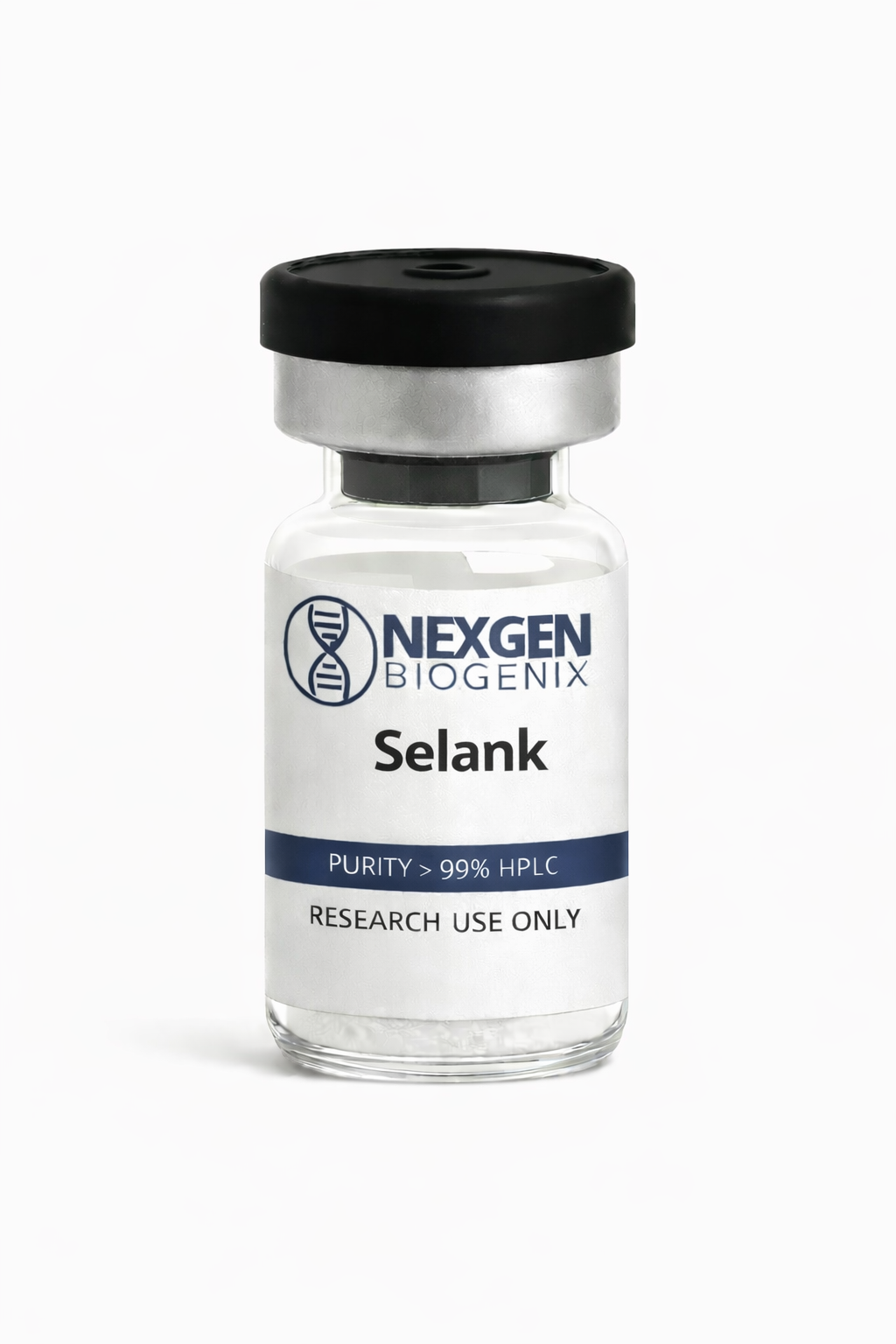
⚠️ Research Use Only (RUO). Not for human or veterinary use. All content on this page is provided for educational and scientific reference purposes only.
Selank — Research Overview (RUO)
Quick Facts
- Full name: L-Threonyl-L-lysyl-L-prolyl-L-arginyl-L-prolylglycyl-L-proline
- Common name / abbreviation: Selank; also known by development codes TP-7 and Selanc
- Synonyms / related names: TP7; Selanc; H-Thr-Lys-Pro-Arg-Pro-Gly-Pro-OH; tuftsin analogue heptapeptide
- Peptide class: Synthetic heptapeptide; tuftsin analogue; regulatory neuropeptide
- Amino acid sequence: Thr-Lys-Pro-Arg-Pro-Gly-Pro (TKPRPGP) — 7 amino acids
- Molecular formula: C₃₃H₅₇N₁₁O₉
- Molecular weight: ~751.88–751.89 Da (free peptide); ~811.93 Da as acetate salt
- CAS number: 129954-34-3 (free peptide); 2703745-90-6 (acetate salt)
- Primary research themes: Anxiety and stress neurobiology; GABAergic and monoaminergic signaling; nootropic and cognitive research models; neuroimmune interactions; BDNF expression studies
- Evidence level: Preclinical (in vitro / animal models) and limited human data from small Russian clinical studies; no large-scale international RCTs published
- Regulatory status: Research Use Only (RUO) in the United States; not FDA-approved as a drug; Selank acetate (TP-7) was removed from FDA Category 2 of the interim 503A bulks list in September 2024 after nominators withdrew their nomination, and was subsequently reviewed by the PCAC in December 2024 — where it was not approved for inclusion on the 503A bulks list (see Section 9)
What Is Selank?
Selank is a synthetic heptapeptide — a chain of seven amino acids — developed at the Institute of Molecular Genetics of the Russian Academy of Sciences in cooperation with the V.V. Zakusov Research Institute of Pharmacology. It was designed as a stabilized analog of tuftsin, a naturally occurring tetrapeptide (Thr-Lys-Pro-Arg) derived from the heavy chain of human immunoglobulin G and produced primarily in the spleen. To improve metabolic stability and extend its duration in biological systems, researchers added a tripeptide extension (Pro-Gly-Pro) to the C-terminus of the tuftsin sequence — yielding Selank’s full sequence: Thr-Lys-Pro-Arg-Pro-Gly-Pro.
The human body naturally produces many peptides — small, protein-like molecules that act as biological messengers throughout the nervous, immune, and endocrine systems — and tuftsin, Selank’s parent molecule, is one such endogenous peptide. Selank itself is a synthetic construct not found naturally in the body, but it was engineered to interact with the same biological pathways as its parent compound, with the deliberate modification of increased resistance to enzymatic breakdown, which makes it more tractable as a research tool.
In the scientific literature, Selank has been described primarily as an anxiolytic and nootropic research compound. It has been investigated in preclinical models for its interactions with GABAergic, dopaminergic, and serotonergic neurotransmitter systems, as well as for immunomodulatory effects on cytokine gene expression. In Russia, a nasal formulation has been registered as a pharmaceutical drug; however, this approval does not extend to the United States, where Selank is classified strictly as a Research Use Only (RUO) compound.
Why Do Researchers Study It?
Researchers are interested in Selank because preclinical and limited clinical studies have described it as a molecularly distinctive anxiolytic and cognitive-modulatory agent with a mechanism of action that may differ meaningfully from classical benzodiazepines. Key areas of scientific investigation include:
- Anxiety neurobiology models: Selank has been studied in rodent anxiety paradigms — including elevated plus maze and forced swim tests — where it has been observed to reduce anxiety-related behaviors, providing a research tool for understanding GABAergic modulation of fear and stress responses.
- GABAergic system research: Studies suggest Selank may allosterically modulate GABA-A receptors, influencing the balance of inhibitory neurotransmission. Researchers use it as a probe for understanding how peptide compounds can interact with the GABA system without the dependency profile associated with classical benzodiazepines.
- Monoamine neurotransmitter studies: Preclinical research has described Selank as affecting serotonin metabolism and dopamine receptor gene expression, making it relevant to investigations into mood regulation and cognitive enhancement pathways.
- BDNF and synaptic plasticity research: Studies have observed that Selank rapidly elevates brain-derived neurotrophic factor (BDNF) expression in the rat hippocampus — a target of significant interest in memory, learning, and neuroprotection research.
- Neuroimmune interactions: Because Selank is derived from tuftsin — a known immunomodulatory peptide — researchers study its effects on cytokine expression profiles, including interleukins IL-6 and IL-2, in models of stress-induced immune dysregulation.
- Neuropeptide stability and pharmacokinetics: Selank serves as a model compound for studying how C-terminal tripeptide extensions (Pro-Gly-Pro) alter the metabolic stability of short peptides in biological fluids, a question relevant to peptide drug design broadly.
Proposed Mechanism (Research Framing)
The following descriptions are drawn from published scientific literature and reflect hypotheses and observations from preclinical and in vitro research. The exact mechanisms of Selank in humans have not been fully established, and no causal claims are made here.
Researchers have proposed that Selank’s anxiolytic properties stem primarily from interactions with the GABAergic neurotransmitter system. Studies suggest that Selank does not bind directly to the classical benzodiazepine site on GABA-A receptors, but may instead act through allosteric modulation — altering the affinity of endogenous GABA ligands for the receptor and thereby influencing the frequency of chloride ion channel opening. This mechanism has been described in the literature as distinct from classical benzodiazepines, potentially accounting for the observed absence of sedation, tolerance, and dependence in animal models. Researchers have noted, however, that the precise binding site and allosteric mechanism have not been fully characterized.
Beyond GABAergic pathways, Selank has been observed in preclinical models to influence monoamine neurotransmitter systems. Gene expression analyses in rat frontal cortex tissue have found that Selank administration is associated with changes in the expression of dopamine receptor genes — including Drd2, Drd1a, and Drd5 — as well as serotonin-related genes. Researchers have proposed that activation of Drd5, in particular, may contribute to observed effects on synaptic plasticity relevant to learning and memory models, though this interpretation is preliminary and based on rodent data.
A third area of mechanistic interest concerns enkephalin metabolism. Small clinical studies have described correlations between Selank administration and changes in leucine-enkephalin half-life in patients with generalized anxiety disorder, suggesting possible involvement of the opioid peptide system in its anxiolytic profile. Researchers have proposed that this enkephalin-stabilizing effect may contribute to Selank’s anti-stress properties, though the mechanistic pathway in humans has not been fully established.
Key Targets Described in the Literature
- GABA-A receptors (allosteric modulation): Described in the literature as a potential site of action through which Selank may alter inhibitory neurotransmission without directly binding benzodiazepine receptor sites.
- Dopamine receptors (Drd1a, Drd2, Drd5): Gene expression studies in rodent frontal cortex have observed altered expression of dopamine receptor genes following Selank administration, with proposed relevance to cognitive and mood regulation pathways.
- Serotonin system: Preclinical studies have described Selank as influencing serotonin metabolism and serotonin receptor gene expression, which researchers have linked to its antidepressant-like profile in animal models.
- BDNF (brain-derived neurotrophic factor): Studies have observed rapid upregulation of BDNF in the rat hippocampus following Selank administration — a target of significant interest in synaptic plasticity and neuroprotection research.
- Leucine-enkephalin / opioid peptide system: Researchers have proposed that Selank may stabilize enkephalin half-life in peripheral blood, which could modulate opioid-mediated anxiety and stress responses, though this pathway requires further investigation.
- Cytokine expression (IL-6, IL-2rg, Xcr1): Reflecting its tuftsin lineage, studies have described Selank as modulating the expression of inflammation-related genes in immune tissues, making it relevant to neuroimmune research models.
Research Applications (RUO Context)
In qualified laboratory settings, Selank is employed as a research tool across neuroscience, immunology, and pharmacology. The following applications reflect how researchers have described using this compound in published studies — not protocols or instructions for any use outside a controlled research environment.
- Rodent anxiety and stress paradigms: Selank has been used in elevated plus maze, open field, forced swim, and chronic mild stress models to probe the relationship between GABAergic modulation and anxiety-related behavior.
- Gene expression and transcriptomic studies: Researchers have used real-time PCR and transcriptomic platforms to measure Selank-induced changes in the expression of genes involved in GABAergic neurotransmission, dopamine signaling, and cytokine production in frontal cortex, hippocampus, and spleen tissue.
- BDNF and neurotrophin assays: Selank has been used as a reference compound in studies measuring BDNF levels in hippocampal tissue, providing a research tool for studying neurotrophic factor regulation.
- Neuroimmune interaction models: Because Selank modulates cytokine gene expression, it is used in cell culture and animal models to study the bidirectional communication between the nervous and immune systems under stress conditions.
- Comparative benzodiazepine pharmacology: Selank’s proposed GABAergic mechanism makes it useful as a comparator compound in studies examining the pharmacological differences between peptide-based and classical small-molecule anxiolytics.
- Peptide stability and metabolic research: Selank’s design — specifically the Pro-Gly-Pro C-terminal extension — makes it a model compound for studying how structural modifications affect peptide half-life and enzymatic degradation in biological matrices.
Evidence Snapshot
► Preclinical Evidence (In Vitro / Animal Models)
- Multiple rodent studies have reported that Selank reduces anxiety-related behaviors in elevated plus maze and open field tests, with effects described as comparable in magnitude to diazepam in some paradigms, though study designs and conditions vary considerably across publications.
- Gene expression analyses in rat frontal cortex have observed that Selank administration is associated with significant changes in the expression of genes involved in GABAergic neurotransmission, dopamine receptor signaling, and serotonin metabolism — with different gene sets affected at 1-hour and 3-hour post-administration time points.
- BDNF upregulation in rat hippocampus has been reported following Selank administration in preclinical studies, a finding that researchers have linked to observed improvements in memory and learning-related behavioral endpoints in animal models.
- Immunological studies in mouse spleen have described Selank as modulating the expression of inflammation-related genes including C3, Il2rg, Xcr1, and Casp1 following a single intraperitoneal injection, consistent with its tuftsin-derived lineage and proposed immunomodulatory activity.
► Human / Clinical Evidence
- A clinical study published in 2008 (Zozulia et al., PMID: 18454096) compared Selank to medazepam in 62 patients with generalized anxiety disorder and neurasthenia; both demonstrated similar anxiolytic effects on Hamilton scale scores, with Selank also showing antiasthenic properties — however, this was a small, single-center study conducted at Russian institutions, and its methodology predates current international RCT standards.
- A small fMRI study in 52 healthy participants examined the effects of Selank and Semax on resting-state functional connectivity, reporting differences in amygdala–temporal cortex connectivity following Selank administration (Panikratova et al., PMID: 32342318); this constitutes early-stage human neuroimaging data and does not establish clinical efficacy or safety.
- As of 2025, large-scale, double-blind, placebo-controlled, internationally registered randomized controlled trials evaluating Selank for any medical indication have not been published in peer-reviewed literature. The existing human evidence base is limited to small studies conducted primarily at Russian research institutions, with limited independent international replication.
Limitations & Open Questions
Selank’s scientific profile is genuinely distinctive — its tuftsin-derived structure, proposed GABAergic mechanism, and dual anxiolytic-immunomodulatory activity make it an unusual research subject. Nevertheless, significant gaps exist between the available evidence and what can be responsibly concluded about its effects in humans. Key limitations include:
- Geographic concentration of research: The substantial majority of Selank’s published research originates from a small number of Russian research institutes. Independent international replication of key findings is limited, which constrains confidence in the generalizability of results.
- Preclinical-to-human translation gap: Most mechanistic data comes from rodent brain tissue and cell culture models. Whether findings related to GABA-A allosteric modulation, BDNF upregulation, and dopamine receptor gene expression translate to human neurobiology has not been established through rigorous clinical trials.
- Small human study sizes: Available clinical studies involve small patient numbers, lack rigorous blinding in some cases, and were conducted in specific patient populations that may not be representative of broader groups.
- Route of administration variability: Preclinical studies have used intranasal, intraperitoneal, and other administration routes; the pharmacokinetics and bioavailability of Selank under different conditions are not uniformly characterized, complicating cross-study comparisons.
- Lack of long-term safety data: No long-term human safety studies for Selank have been published in accessible peer-reviewed literature. The immunomodulatory activity (cytokine modulation) raises open questions about long-term immune effects that remain unstudied in humans.
- Regulatory uncertainty: Selank’s nomination for FDA 503A compounding consideration was withdrawn by the nominator in 2024, and the PCAC declined to approve it for inclusion on the 503A bulks list at its December 2024 meeting. This regulatory trajectory underscores the importance of using only RUO-grade, properly documented material for laboratory research.
Quality & Sourcing
For researchers working with Selank in preclinical or in vitro settings, compound quality is a foundational experimental variable. Because Selank is a heptapeptide with multiple chiral centers and a specific stereochemical configuration, impurities — including peptide fragments, d-amino acid epimers, or residual synthesis reagents — can introduce significant confounds. When sourcing Selank for laboratory use, the following documentation standards are considered essential:
- Lot Traceability: Each batch should carry a unique lot number linked to its complete manufacturing record, enabling researchers to trace experimental results to a specific production lot and identify batch-to-batch variability in purity or stereochemical profile.
- Certificate of Analysis (COA): A COA from a qualified analytical laboratory should confirm peptide identity (via HPLC and high-resolution mass spectrometry confirming the molecular weight of ~751.88 Da for the free peptide), purity (≥98% is a commonly cited research-grade standard), stereochemical integrity, and freedom from endotoxins, residual solvents, and heavy metal contaminants.
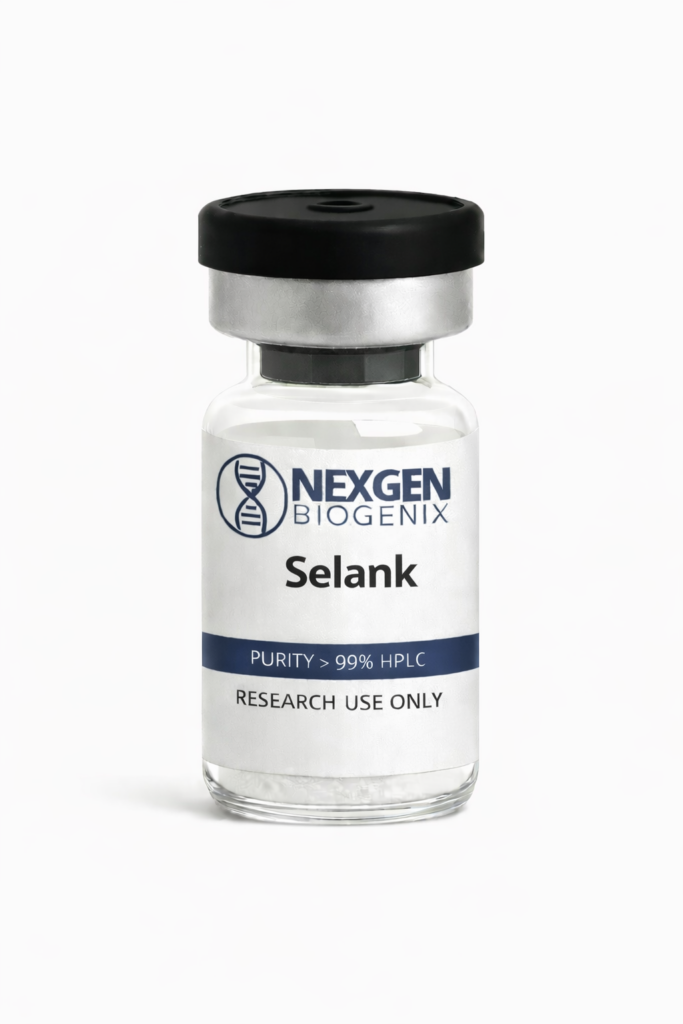
- Storage & Labeling: Research-grade Selank should be clearly labeled Research Use Only, stored as a lyophilized powder under dry, cool, light-protected conditions, and accompanied by a defined retest or expiration date. Once reconstituted, aliquots should be handled according to established peptide stability best practices to prevent degradation and aggregation.
📄 Questions about documentation or purity verification? Contact our support team or request a COA from our library.
US Regulatory Snapshot (Updated 2025)
- RUO context: Selank is sold and distributed in the United States strictly as a Research Use Only compound. It is not a drug, not a dietary supplement, and not approved for any therapeutic, cosmetic, or veterinary application. The FDA has noted that RUO labeling cannot be used as a shield for products actually intended for human use — purchasing or using Selank for human self-administration would be outside its labeled and legal use and potentially subject to enforcement action.
- Category 1 / Category 2 / 503A — what these mean (and what they do not): Under the FDA’s 503A compounding framework, bulk drug substances were placed into interim categories during the period when FDA was developing its official bulks list. Category 1 indicated a substance was nominated and not identified as presenting significant safety risks, allowing compounders to use it under an enforcement discretion policy. Category 2 indicated the substance was nominated but raised significant safety concerns, effectively prohibiting its compounding. Neither Category 1 nor Category 2 status constitutes FDA approval. These are interim administrative designations — not evaluations of clinical efficacy or safety — and they do not authorize any human use outside of licensed compounding under applicable conditions.
- FDA guidance, January 7, 2025: The FDA released final guidance stating that it does not intend to place new bulk drug substance nominations into interim Categories 1, 2, or 3 for substances nominated on or after January 7, 2025, while its evaluation of nominated substances under section 503A continues. This guidance signals a structural change in the categorization framework that all researchers and compounders should monitor.
- Selank-specific regulatory history (as of 2025): Selank acetate (TP-7) was placed in Category 2 of the FDA’s interim 503A bulks list in September 2023, signaling FDA safety concerns. In September 2024, the nominator withdrew the nomination, and FDA removed Selank from Category 2 — a procedural change, not a safety clearance. Selank was subsequently reviewed by the Pharmacy Compounding Advisory Committee (PCAC) at its December 4, 2024 meeting, where it was not approved for inclusion on the 503A bulks list. As of 2025, Selank is not on the approved 503A bulks list and is not approved by the FDA as a drug product under any NDA or ANDA. It remains classified as RUO for laboratory research purposes only.
- Stay current: Peptide regulatory status in the United States is actively evolving. Researchers and institutions are strongly advised to monitor the FDA’s compounding pages at FDA.gov for updates to the 503A bulks list, and to consult a qualified regulatory attorney or compliance professional for institution-specific guidance before ordering or using any research compound.
Frequently Asked Questions
Does the body naturally produce peptides related to Selank?
Yes — Selank’s parent molecule, tuftsin, is a naturally occurring peptide produced in the human body, specifically in the spleen as a fragment of the heavy chain of immunoglobulin G. More broadly, the human body naturally produces many peptides — small, protein-like molecules that act as biological messengers — including well-known examples such as insulin (regulating blood sugar), oxytocin (involved in social bonding), endorphins (modulating pain and mood), and dozens of neuropeptides involved in regulating anxiety, appetite, sleep, and immune function. Selank itself is a synthetic compound not found naturally in the body; it was engineered by extending tuftsin’s sequence to improve metabolic stability for research purposes.
Is Selank FDA-approved?
No. Selank is not FDA-approved as a drug for any indication in the United States. It has not been evaluated under a New Drug Application (NDA) process, and has not received FDA approval for safety or efficacy in any human condition. While a nasal formulation of Selank is registered as a pharmaceutical drug in Russia and some post-Soviet countries, this foreign registration has no standing with the FDA and does not constitute US approval. Selank acetate was reviewed by the FDA’s Pharmacy Compounding Advisory Committee (PCAC) in December 2024 for potential inclusion on the 503A compounding bulks list, where it was not approved. All Selank sold on this platform is strictly Research Use Only (RUO) and is not intended or labeled for human use of any kind.
Is anything on this page medical advice?
No. Nothing on this page constitutes medical advice, clinical guidance, or a recommendation for human use of any kind. This page is an educational reference for qualified researchers and is intended solely to summarize what has been described in the scientific literature about Selank as a research tool. If you have health or anxiety-related questions or concerns, please consult a licensed healthcare provider. If you have regulatory questions regarding peptide compounds, consult a qualified regulatory attorney or compliance professional.
References (Starting Points)
- Zozulia AA, Neznamov GG, Suslov VV, et al. “Efficacy and possible mechanisms of action of a new peptide anxiolytic selank in the therapy of generalized anxiety disorders and neurasthenia.” Zh Nevrol Psikhiatr Im S S Korsakova. 2008;108(4):38–48. PMID: 18454096. View on PubMed
- Volkova A, Shadrina M, Kolomin T, et al. “Selank Administration Affects the Expression of Some Genes Involved in GABAergic Neurotransmission.” Frontiers in Pharmacology. 2016;7:31. PMID: 26924987. PMC: PMC4757669. View on PMC
- Semenova TP, Kozlovskii II, Zakharova NM, Kozlovskaya MM. “Peptide Selank Enhances the Effect of Diazepam in Reducing Anxiety in Unpredictable Chronic Mild Stress Conditions in Rats.” Bulletin of Experimental Biology and Medicine. 2017;162(4). PMC: PMC5322660. PMID: 28280289. View on PMC
- Shevchenko KV, Nagaev IYu, Shevchenko VP, Myasoedov NF. “Peptide-based Anxiolytics: The Molecular Aspects of Heptapeptide Selank Biological Activity.” Current Protein & Peptide Science. 2018;19(10). PMID: 30255741. View on PubMed
- Kolomin T, Morozova M, Volkova A, et al. “The temporary dynamics of inflammation-related genes expression under tuftsin analog Selank action.” Molecular Immunology. 2014;58(1):50–55. PMID: 24291245. View on PubMed
- Panikratova YR, Lebedeva IS, Rumshiskaya AD, et al. “Functional Connectomic Approach to Studying Selank and Semax Effects.” Bulletin of Experimental Biology and Medicine. 2020;168(6). PMID: 32342318. View on PubMed
- U.S. Food and Drug Administration. “Bulk Drug Substances Nominated for Use in Pharmacy Compounding Under Section 503A of the Federal Food, Drug, and Cosmetic Act.” Updated 2025. View on FDA.gov
- U.S. Food and Drug Administration. “Interim Policy on Compounding Using Bulk Drug Substances Under Section 503A of the Federal Food, Drug, and Cosmetic Act.” Federal Register. January 7, 2025. View on Federal Register
RESEARCH USE ONLY — REGULATORY NOTICE
All products and information presented on this website are intended exclusively for in-vitro laboratory research and scientific investigation by qualified researchers. These products are not intended for human consumption, veterinary use, cosmetic application, or therapeutic purposes of any kind. Nothing on this page has been evaluated by the U.S. Food and Drug Administration (FDA). These products are not intended to diagnose, treat, cure, or prevent any disease or medical condition. Researchers are responsible for ensuring compliance with all applicable local, state, and federal regulations before ordering or using any research compound. For questions about regulatory status, consult a qualified regulatory attorney or compliance professional.