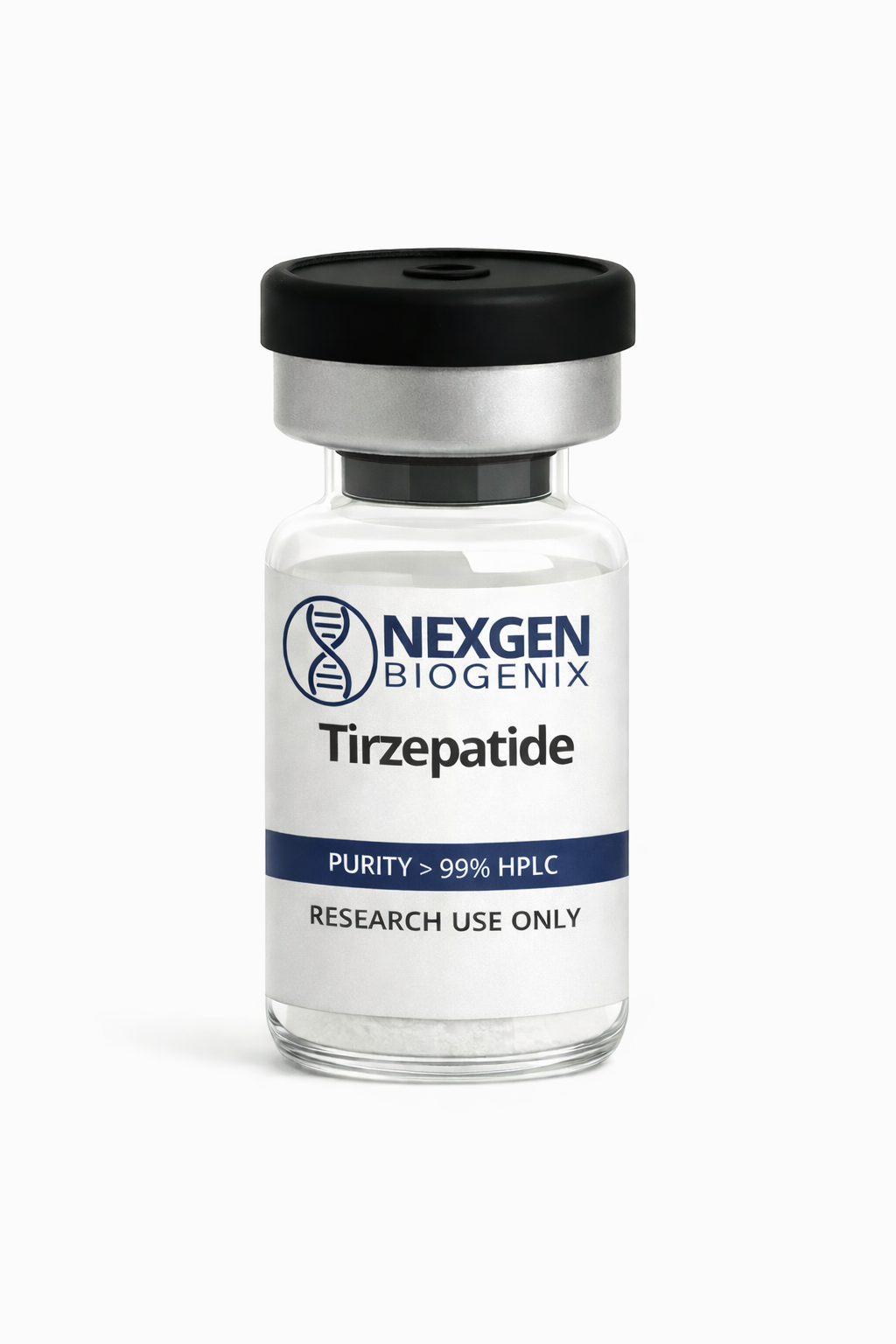
⚠️ Research Use Only (RUO). Not for human or veterinary use. All content on this page is provided for educational and scientific reference purposes only. Tirzepatide — Research Overview (RUO)
Quick Facts
- Common Name: Tirzepatide
- Research Code: LY3298176
- Trade Names (pharmaceutical): Mounjaro · Zepbound (Eli Lilly & Company)
- Peptide Class: Synthetic acylated polypeptide · Dual GIP/GLP-1 receptor agonist
- Amino Acids / MW: 39 amino acids · 4,813.53 Da
- CAS Number: 2023788-19-2
- Primary Research Themes: GIP/GLP-1 receptor pharmacology · Incretin biology · Metabolic signaling · Insulin secretion · Adipokine regulation
- Evidence Level: Extensive clinical data — SURPASS & SURMOUNT Phase 3 programs · Multiple ClinicalTrials.gov entries
- Regulatory Status: FDA-approved prescription drug (Mounjaro, 2022; Zepbound, 2023) · Supplied here strictly as RUO reference material
What Is Tirzepatide?
The human body naturally produces many peptides — small protein-like molecules that act as biological messengers, coordinating everything from hunger signals to insulin release. Two of those naturally occurring peptides, GLP-1 (glucagon-like peptide-1) and GIP (glucose-dependent insulinotropic polypeptide), are released from the gut after eating and signal the pancreas to release insulin.
Tirzepatide is a synthetic 39-amino-acid peptide engineered to mimic and activate both of those natural signaling molecules simultaneously — earning it the nickname “twincretin” in the scientific literature. Unlike earlier compounds that targeted only the GLP-1 receptor, tirzepatide was engineered to engage the GIP receptor with higher affinity while also showing a distinct signaling pattern at the GLP-1 receptor, a property scientists describe as “biased agonism.”
From a basic science perspective, tirzepatide serves as a valuable reference tool for exploring incretin receptor biology, pancreatic beta-cell signaling, and the intersection of metabolic and appetite regulation pathways.
Why Do Researchers Study It?
Researchers are interested in tirzepatide because it offers a uniquely engineered molecule for dissecting dual incretin receptor biology:
- Its dual GIP/GLP-1 agonism allows researchers to isolate the relative contributions of each receptor pathway to glucose homeostasis and energy balance in experimental models.
- The biased agonism at the GLP-1 receptor — preferential cAMP signaling over beta-arrestin recruitment — provides a mechanistic lens for studying receptor trafficking and downstream signaling behavior.
- Its modular peptide architecture (GIP-based sequence with amino acid substitutions and a C20 fatty acid moiety) offers insights into peptide engineering strategies for extending half-life and tuning receptor selectivity.
- Research has examined its effects on adiponectin levels, insulin sensitivity markers, and beta-cell function, raising broader questions about incretin biology beyond glycemic control.
- Ongoing investigations explore relevance to hepatic lipid metabolism, cardiovascular function, and neurological signaling — all active areas of preclinical inquiry.
Proposed Mechanism (Research Framing)
All mechanistic claims reflect the current scientific literature. The exact mechanism in humans has not been fully established.
Studies suggest that tirzepatide acts as a co-agonist at two G protein-coupled receptors: the GIP receptor (GIPR) and the GLP-1 receptor (GLP-1R). Both are naturally activated by incretin hormones released from intestinal cells in response to nutrient intake. Research published in JCI Insight (Willard et al., 2020) describes tirzepatide as an “imbalanced and biased” dual agonist — showing greater receptor occupancy at the GIPR than at the GLP-1R under clinically relevant concentrations.
At the GLP-1 receptor, tirzepatide has been described in the literature as preferentially engaging the cyclic AMP (cAMP) signaling pathway over beta-arrestin recruitment. Researchers have proposed this signaling bias may influence receptor internalization kinetics and insulin secretory responses in pancreatic islet cells. Experiments in primary islet models observed that beta-arrestin1 limits the insulin response to native GLP-1 but not to tirzepatide or GIP — suggesting a mechanistic basis for the enhanced insulinotropic activity described in preclinical models.
Key Targets Described in the Literature
- GIPR — primary target; higher receptor occupancy at steady state
- GLP-1R — secondary target; biased cAMP signaling observed in vitro
- Downstream: glucose-stimulated insulin secretion, glucagon suppression, adiponectin modulation
- CNS: GIPR and GLP-1R co-expression in hypothalamic regions studied in preclinical models
Research Applications (RUO Context)
Tirzepatide serves as a reference compound and pharmacological tool in laboratory research settings. Contexts where it has been applied include:
- Receptor binding assays using transfected HEK-293 cells expressing human GIPR and GLP-1R to characterize agonist potency and selectivity.
- In vitro beta-cell signaling examining cAMP generation, beta-arrestin recruitment, and insulin secretory responses in pancreatic islet preparations.
- Comparative pharmacology alongside native GIP, native GLP-1, semaglutide, and exenatide to map receptor-specific contributions to metabolic endpoints.
- Animal model research (rodent and primate) investigating dual incretin receptor activation and its association with body weight regulation, glycemic response, and adipose tissue biology.
- Neurological context studies exploring hypothalamic appetite circuits and energy homeostasis in preclinical systems.
- Hepatic and cardiometabolic models investigating MAFLD, renal biology, and cardiovascular function.
Evidence Snapshot
► Preclinical Evidence (In Vitro / Animal Models)
- In transfected cell models, studies observed greater GIPR occupancy relative to GLP-1R, consistent with the compound’s imbalanced design.
- Beta-arrestin recruitment studies in primary islet preparations suggested tirzepatide’s biased GLP-1R agonism may reduce the inhibitory effect of beta-arrestin1 on insulin secretion compared to native GLP-1.
- Rodent studies described in the literature observed reductions in body weight and food intake with dual incretin receptor agonism; researchers note these effects have not been fully replicated mechanistically in human studies.
- Preclinical investigations observed effects on adiponectin levels, hepatic lipid accumulation, and insulin sensitivity markers; translation to human biology requires further study.
► Human / Clinical Evidence
- The SURPASS phase 3 program (NCT03954834 and related) evaluated tirzepatide in adults with type 2 diabetes across multiple comparator arms, including placebo, semaglutide 1.0 mg, and basal insulins.
- The SURMOUNT phase 3 program (SURMOUNT-1, NCT04184622) studied tirzepatide in adults with obesity or overweight without type 2 diabetes, with body weight as the primary endpoint over 72 weeks.
- Additional registered studies explore potential relevance to heart failure (SUMMIT, NCT04847557), NAFLD, chronic kidney disease, and sleep apnea. Full trial registry: ClinicalTrials.gov — search “tirzepatide.”
Limitations & Open Questions
Despite tirzepatide’s extensive evidence base, important scientific questions remain open:
- The relative contribution of GIPR vs. GLP-1R agonism to observed weight loss in humans remains incompletely understood; robust GIP-mediated weight effects seen in rodents have not been definitively demonstrated in human mechanistic studies.
- The long-term significance of anti-drug antibody formation (observed in over half of treated subjects) and its interaction with native incretin hormones requires continued study.
- Mechanistic studies on CNS effects — particularly hypothalamic appetite circuits — have been largely inferred from rodent models; human neuroimaging and mechanistic data remain sparse.
- The degree to which biased GLP-1R agonism translates into clinically meaningful differences in receptor desensitization or long-term signaling outcomes in humans has not been fully characterized.
- As a reference compound, purity, lot consistency, and structural integrity are critical variables; results across laboratories may vary with source material quality.
- Regulatory complexity around compounding and supply creates challenges for researchers seeking consistent access outside established pharmaceutical supply chains.
Quality & Sourcing
For researchers requiring tirzepatide as a reference standard or mechanistic tool, documentation quality is essential for reproducible science.
- Lot Traceability: Each batch carries a unique lot number enabling full chain-of-custody documentation from synthesis to delivery.
- Certificate of Analysis (COA): Independent third-party HPLC and mass spectrometry testing confirms purity and molecular identity before release.
- Storage & Labeling: Products are clearly labeled with recommended storage conditions to support research reproducibility and structural integrity over extended experiments.
📄 Questions about documentation or purity verification? Contact our support team or request a COA from our library.
US Regulatory Snapshot (Updated 2025)
- RUO Context: The tirzepatide supplied through this website is offered strictly for in-vitro laboratory research. It is not a drug product, supplement, or medical device as supplied here, and is not intended for any therapeutic, clinical, or human use.
- Tirzepatide is an FDA-approved prescription drug: Unlike most RUO peptides, tirzepatide has received full FDA approval — as Mounjaro (type 2 diabetes, May 2022) and Zepbound (chronic weight management, November 2023). The RUO material offered here is not the approved pharmaceutical product and has not undergone FDA premarket review.
- Category 1 / 503A Framework: The FDA 503A interim policy (finalized January 7, 2025) established a framework for evaluating bulk substances for compounding. Category 1 status is NOT FDA approval, nor does it authorize therapeutic use. Per that same guidance, the FDA does not intend to categorize newly nominated bulk substances into interim categories while evaluation continues. Tirzepatide, as an already-approved drug, is governed instead by the “essentially a copy” restrictions under Sections 503A and 503B of the FD&C Act.
- Compounding Status as of Early 2025: FDA determined the tirzepatide shortage was resolved in December 2024. Enforcement discretion periods for 503A compounders ended February 18, 2025, and for 503B outsourcing facilities ended March 19, 2025. Compounding an “essentially a copy” of tirzepatide is now restricted absent documented medical necessity.
- Stay Current: Researchers and institutions should monitor FDA.gov and consult qualified legal/regulatory counsel for the most current compliance requirements.
Frequently Asked Questions
Does the body naturally produce peptides?
Yes — and this is one of the reasons incretin peptides are so scientifically fascinating. The human body naturally produces many peptides, including familiar ones like insulin, oxytocin, and endorphins, as well as the incretin hormones GIP and GLP-1 that tirzepatide was engineered to mimic. These naturally occurring signaling molecules regulate everything from blood sugar to appetite to stress response, which is why synthetic analogs serve as valuable tools for studying those pathways in controlled laboratory settings.
Is tirzepatide FDA-approved?
Yes — unlike most compounds in the RUO peptide research space, tirzepatide is an FDA-approved prescription drug, available under the brand names Mounjaro and Zepbound (Eli Lilly). The RUO reference material offered through this website is not the approved pharmaceutical product, is not intended for human use, and has not undergone FDA premarket review for safety or efficacy.
Is anything on this page medical advice?
No. This page is for educational and scientific reference purposes only. Nothing here constitutes medical advice, a treatment recommendation, or encouragement to use this compound in any way outside of a licensed research context. If you have questions about tirzepatide as a medication, speak with a licensed healthcare provider.
References (Starting Points)
- Coskun T, Sloop KW, Loghin C, et al. “LY3298176, a novel dual GIP and GLP-1 receptor agonist.” Molecular Metabolism. 2018;18:3–14. PMID: 30473097. View on PMC
- Willard FS, Douros JD, Gabe MBN, et al. “Tirzepatide is an imbalanced and biased dual GIP and GLP-1 receptor agonist.” JCI Insight. 2020;5(17):e140532. PMID: 32730232. View on PMC
- Nauck MA, D’Alessio DA. “Tirzepatide, a dual GIP/GLP-1 receptor co-agonist.” Cardiovascular Diabetology. 2022;21(1):169. PMID: 36050763. View on PubMed
- Min T, Bain SC. “The Role of Tirzepatide in the Management of Type 2 Diabetes: The SURPASS Clinical Trials.” Diabetes Therapy. 2021;12(1):143–157. PMID: 33159657. View on PMC
- Rosenstock J, Wysham C, Frías JP, et al. “Efficacy and safety of tirzepatide in patients with type 2 diabetes (SURPASS-1).” The Lancet. 2021;398(10295):143–155. PMID: 34186022.
- Ma Z, Liu X, Ilyas I, et al. “Research Progress on the GIP/GLP-1 Receptor Coagonist Tirzepatide.” Journal of Diabetes Research. 2023;2023:6974274. PMID: 37131530. View on PMC
- U.S. Food and Drug Administration. “FDA Approves New Medication for Chronic Weight Management.” FDA.gov. November 2023. View on FDA.gov
- Federal Register. “Interim Policy on Compounding Using Bulk Drug Substances Under Section 503A.” FR Doc. 2024-31546. January 7, 2025. View on FederalRegister.gov
RESEARCH USE ONLY — REGULATORY NOTICE
All products and information presented on this website are intended exclusively for in-vitro laboratory research and scientific investigation by qualified researchers. These products are not intended for human consumption, veterinary use, cosmetic application, or therapeutic purposes of any kind. Nothing on this page has been evaluated by the U.S. Food and Drug Administration (FDA). These products are not intended to diagnose, treat, cure, or prevent any disease or medical condition. Researchers are responsible for ensuring compliance with all applicable local, state, and federal regulations before ordering or using any research compound. For questions about regulatory status, consult a qualified regulatory attorney or compliance professional.